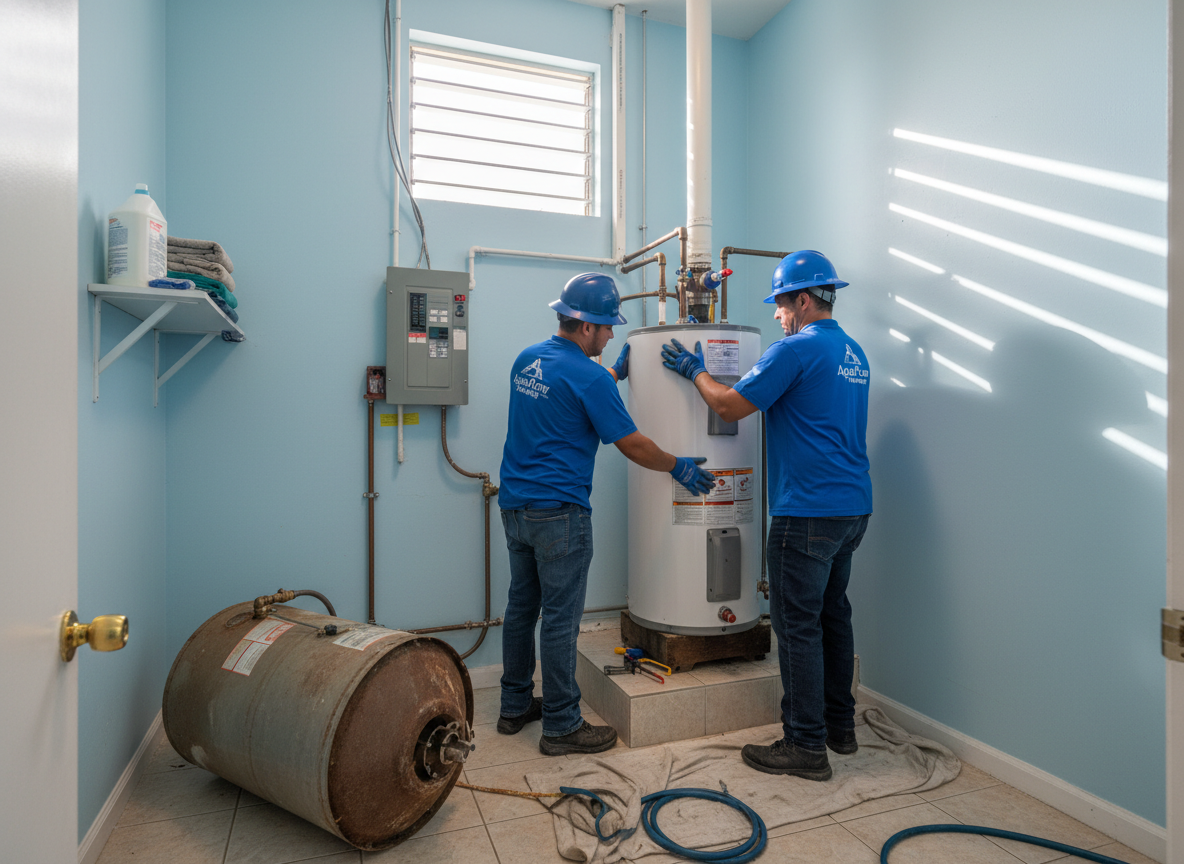
Miami Beach is a city in its own right and covers the whole island from South Pointe north past 41st Street. Most water heater work here happens in buildings rather than houses, and in a building the appliance is never the only thing involved: the riser, the pressure-reducing valve and the closet it shares with the air handler all shape the job.
Hallway closets and tower risers
The mid-rise blocks that make up much of the island keep the heater in a hallway closet at the back of the flat, behind louvred doors, with the air handler alongside. Those closets are tight and a replacement has to fit the same footprint or the doors will not close. In the taller buildings along Collins Avenue and the bay side, water arrives through a riser at the top of its range, and a relief valve that drips is often reporting the building's pressure rather than a fault in the tank. Measuring at a hose bib before condemning a valve is the first step, not the last.
The streets behind the oceanfront
Not all of Miami Beach is towers. The single-family streets west of Collins, around Flamingo Park and out towards Sunset Harbour, are quiet blocks of 1930s to 1950s houses with garages, carports and exterior utility closets. Units there see salt air with no high-rise to shelter them, so the fittings corrode on the outside while the tank fails from scale on the inside.
Permits and placement
City of Miami Beach issues the permits for work on the island, and its counter lists same-for-same water heater replacement among the plumbing permits handled without plans. A change of fuel type, a move to another location or a first installation is a different application. Placement is part of the planning too: much of the island lies in a flood zone, and where the unit sits in relation to the required elevation decides whether a replacement can simply take the old unit's place.
Start on the contact page. Note the cross street, the floor, and whether the unit is in a closet, a garage or a shared mechanical room.