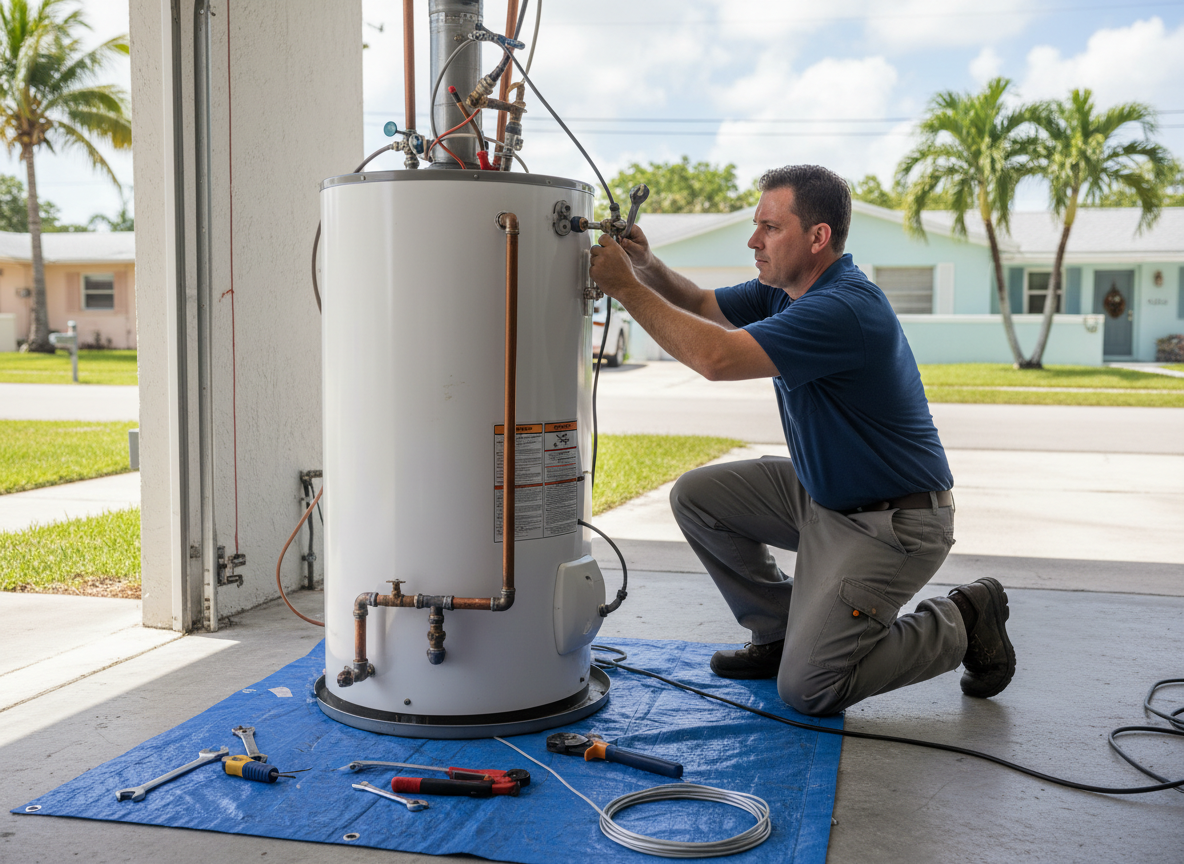
Water heater repair in Miami starts with a fault, not a part. A unit that has stopped heating, leaks at its base, trips a breaker, smells of gas or empties halfway through a shower is reporting something specific. The repair is to test until that report is identified, confirm it, and then fix it.
What Water Heater Repair Covers in Miami
The scope runs from the cold-water inlet to the hot-water outlet, plus every safety device that keeps the unit from becoming a problem. On a storage tank that means the heating elements, thermostats, dip tube, anode rod, temperature and pressure relief valve, expansion tank, drain valve, gas control valve, thermocouple or flame sensor, igniter, burner, flue hood and the fittings that join the tank to the house piping. On a tankless unit it means the heat exchanger, flow sensor, inlet filter, gas valve, igniter, flame rod, venting and the control board that reads all of them. On a heat pump water heater it adds the compressor, fan, evaporator and condensate line.
Plenty of faults are not component failures at all. Water pressure that is too high can make a relief valve weep. A failed expansion tank can do the same on a closed system. A closet without enough combustion air can shut a gas unit down intermittently. A loose connection at a junction, a corroded element terminal or an undersized breaker can look exactly like a dead heater. The diagnosis has to separate those causes from a failed part, because replacing a relief valve on a system with no expansion control only buys a few weeks.
What repair does not cover matters just as much. A split tank shell, a heat exchanger that has perforated, or a gas valve body that is no longer made for an obsolete unit are not repair jobs. They are replacement decisions, and saying so plainly is part of the work.
Signs That Point to a Repair Rather Than a Replacement
No hot water at all is the clearest symptom, and it splits by fuel. On an electric tank it usually means a tripped breaker, a failed upper element, a thermostat that has drifted or a broken wire. On a gas unit it points to the pilot, the igniter, the thermocouple, the gas valve or a safety lockout caused by a venting problem. None of those require a new tank.
Insufficient hot water is a different fault. A tank that heats but empties quickly often has a failed lower element, a thermostat set too low, a dip tube sending cold water straight to the outlet, or a floor packed with sediment. In Miami-Dade's water, sediment is the usual suspect: scale accumulates steadily, and a tank that has never been flushed can lose a meaningful share of its capacity to mineral build-up.
Rumbling, popping or a kettle-like noise during recovery is scale. Water trapped under the mineral layer boils and pops against the element or the tank floor. While the tank is sound, that is a repair symptom: flush, descale and check the anode. Left alone, the same scale overheats the steel and shortens the life of the tank.
Water at the base of the unit has to be traced before it is treated as a failed tank. A leaking relief valve, a loose drain valve, a weeping element gasket, a corroded nipple or condensation on a cold inlet pipe all put water on the floor. A tank leaking through its shell is finished. The difference matters, because one is a repair and the other is not.
Discoloured hot water, a sulphur smell on the hot side only, a breaker that trips when the element energises, an error code on a tankless display, or a unit that cycles every few seconds are all diagnosable. So is a tankless heater that delivers a burst of cold water before it warms, which usually points to a flow sensor or a scaled heat exchanger rather than a dead unit.
A relief valve that discharges on an upper floor of a downtown or Brickell tower is a special case. In a high-rise, the water arriving at the unit has passed through a pressure-reducing valve. When that valve fails, pressure climbs and the relief valve reports it. The valve is doing its job; the pressure control is the fault.
Gas is the one symptom that changes the order of everything. A smell of gas means the area is left alone: no switching, no flames, no attempt to relight. The gas is shut off if it can be reached safely, the space is ventilated, and the utility is called. Diagnosis begins after that.
How a Water Heater Repair Visit Runs
The visit starts at the nameplate. Make, model, capacity, fuel type, serial number and date code give the age of the unit and identify the design being worked on. A tank installed on Belle Isle in the 1990s and one installed last year can look similar from the outside and behave nothing alike.
Isolation comes next. Water is shut off at the inlet, and power or gas is isolated at the breaker or valve. The floor is protected, and on an attic, second-floor or service-balcony installation the pan and platform are checked for water before anything is moved. A full tank that has been seeping is how ceilings get damaged.
Testing then runs in a fixed order. Supply voltage and the breaker first, because a dead circuit mimics every electrical fault. Then the thermostats and elements, measured for continuity and resistance rather than assumed. On gas, the order is gas supply, pilot or ignition, thermocouple or flame signal, then the valve. Water pressure and the expansion tank come next wherever a relief valve has been discharging.
Once the fault is confirmed, it is explained with the reasoning attached: what failed, why it failed, whether the rest of the unit is sound, and what the alternative would involve. The repair is then carried out, connections are checked, and on a tank the unit is refilled and purged of air before power or fuel is restored.
The last step is a leak check at every joint that was opened, a temperature check at the outlet, and a walk-through of the relief valve, the shutoff and the anode. A repair that restores hot water but leaves a blocked flue or a dead expansion tank has not finished the job.
What Is Included in the Repair Work
A repair includes the diagnostic work, not just the swap. The unit is assessed as a system: supply, controls, heating components, tank, safety devices and connections. Where a fault has a knock-on effect, that is dealt with at the time rather than left to become a second visit. A failed element on a scaled tank is a chance to flush the tank, not a reason to seat a new element into a mineral bed.
Consumables are part of it. Element gaskets, nipple seals, thread sealant, flex connectors where the existing ones are corroded, and a new drain valve where the old one no longer closes are small parts that decide whether a repair holds. Reusing a hardened gasket to save ten minutes is how a repair becomes a leak.
Safety devices are checked even when they are not the reported fault. The temperature and pressure relief valve, the expansion tank, the shutoff valve and the venting on a gas unit are inspected because hot water restored around a blocked flue or a dead expansion tank is not a safe result.
The handover is part of the work too. Settings are left where they should be, the shutoff is identified, and any maintenance the unit needs is explained in terms of what it prevents. If the repair has bought time on a unit near the end of its life, that is stated plainly so the next decision is not a surprise.
Miami Conditions That Change How These Units Fail
Water chemistry is the biggest local factor. Miami-Dade's supply comes from the Biscayne Aquifer, and the regional plants lime-soften it specifically to reduce hardness before it reaches a tap. Softening reduces scale; it does not eliminate it. Calcium and magnesium still settle on the hottest surfaces in the system, which in an electric tank is the element and in a gas tank is the floor above the burner. A tank that is flushed periodically lasts longer here than one that never is.
Where the heater sits changes what a failure looks like. Ground-floor garages and utility rooms in Little Havana, Little Haiti and North Bay Village show a leak as water spreading across concrete. Attic and second-floor chases, common in Florida construction from the 1980s onward, hide the same leak until it reaches a ceiling. In a tower, the unit is usually in a closet fed from a riser, so access, isolation and building rules shape the visit as much as the appliance does.
Salt air is the quiet one. On the islands, along South Beach and on Key Biscayne, vent terminals, gas connections, screws and electrical enclosures corrode faster. A rusted flue collar or a green connection at a gas valve is a safety finding, not a cosmetic one, and it is why those parts are looked at rather than assumed sound.
Permits matter here even for repair, because the line between repair and replacement is a legal one. The Florida Building Code requires a permit to replace a plumbing system component, and the authority depends on the address: islands along the Venetian Causeway fall under different municipalities, with unincorporated addresses under Miami-Dade County. City of Miami Beach treats a same-for-same water heater replacement as an over-the-counter plumbing permit that needs no plans; anything that changes fuel type or location is a different application. Repair that does not alter the unit's approval sits on the other side of that line.
Storm season adds its own failure modes. Atlantic hurricane season runs from June 1 to November 30, and Miami's summers bring lightning, grid switching and flooding. A surge can take out a control board or an element with no visible damage. A ground-floor unit that has taken on water needs its burner, valve and controls assessed before it is energised. Both are ordinary calls in a Miami September.
Finally, the age of the building shapes the pipework around the heater. Mid-century blocks in South Beach and Overtown often have shutoffs that no longer close and connectors that have been in place for decades. Checking them is part of the assessment, because a repair cannot be completed safely on a valve that will not hold.
Related Repair Work
Most faults fall into a handful of repeat categories. Each of the items below is handled as part of the repair visit rather than sold as a separate job, and the list is a guide to what the work usually involves.
Water Heater Repair Services We Offer
✓Heating Element and Thermostat Work
Electric tanks lose hot water when an element or thermostat fails. Elements are tested for resistance rather than assumed, and the tank is flushed while it is open so the new part does not seat into scale.
✓Thermocouple, Igniter and Flame Sensor Work
A gas unit that will not stay lit usually has a flame-sensing fault rather than a dead tank. The pilot assembly, igniter and flame rod are cleaned or replaced, and the burner is checked while the unit is open.
✓Gas Control Valve and Burner Service
Intermittent shutdowns and weak recovery on gas units often trace to the control valve, a blocked burner orifice or a flue that is not drafting. Valve, burner and venting are checked together.
✓Relief Valve and Expansion Tank Replacement
A valve that weeps is either doing its job against excess pressure or has failed. Supply pressure and the expansion tank are checked first, so the new valve is not asked to handle a closed system with nowhere to expand.
✓Sediment Flush and Tank Descaling
Aquifer water leaves scale on the tank floor and the elements. A flush removes loose sediment, and descaling dissolves the hardened layer that causes rumbling and short element life.
✓Anode Rod Inspection and Replacement
The anode is what protects the steel tank from corrosion. Checking it while the unit is open is the most direct way to learn whether a tank has years left or is being consumed from the inside.
✓Tankless Descaling and Sensor Repair
Tankless units in Miami scale faster than owners expect. Descaling the heat exchanger, cleaning the inlet filter and testing the flow sensor resolves most cold-water and error-code complaints.
✓Leak Tracing and Tank Assessment
Water at the base is traced to its source: fitting, element gasket, drain valve, relief discharge or the shell itself. Only a shell failure ends the unit; the rest are repairs.
How it works
- 1
Record the Unit
Make, model, capacity, fuel type, serial and date code are recorded first, along with where the heater sits and how it is vented. That sets the expected behaviour before any test begins.
- 2
Isolate and Protect
Water is shut off at the inlet and power or gas is isolated at the breaker or valve. Floors are protected, and on an attic, balcony or second-floor unit the pan is checked for water before anything is moved.
- 3
Test in Order
Supply first, then controls, then heating components, then the tank and connections. Water pressure and expansion control are checked wherever a relief valve has been discharging.
- 4
Confirm and Explain
The confirmed fault is explained along with the condition of the rest of the unit. Where repair and replacement are both viable, both are described, including what each assumes about the tank.
- 5
Carry Out the Repair
The agreed work is done with new gaskets, seals and connectors where the old ones are tired. Safety devices are checked as part of the visit, not left for later.
- 6
Commission and Hand Over
The unit is filled, purged, brought to temperature and leak-checked at every joint. Settings, the shutoff location and the maintenance it needs in Miami water are explained before the technician leaves.