Miami water heater work
Water Heater Repair in Miami, FL
Tank, tankless and heat pump water heaters, gas and electric, across Miami and Miami-Dade County. The business is based at 1224 S Venetian Way, Miami, FL 33139, USA, on the Venetian Causeway, and every job starts by establishing what the heater is actually doing before a part is chosen.
- Tank, tankless and heat pump units
- Gas and electric
- Repair, replacement and installation
- Miami and Miami-Dade coverage
Water Heater Repair Miami FL
Miami, FL
The business
About Water Heater Repair Miami FL
Water Heater Repair Miami FL is a water heater business at 1224 S Venetian Way, Miami, FL 33139, USA.
The work is domestic hot water only: storage tanks, tankless units, heat pump water heaters, and the fittings, venting and safety devices around them. That narrow scope is deliberate. Water heating sits where plumbing, gas, electricity and building code meet, and a company that spreads itself across general plumbing, drainage and remodeling rarely gets deep enough in any of them to diagnose a stubborn fault.
- Based at 1224 S Venetian Way, Miami, FL 33139, USA
- Repair, replacement and installation of tank and tankless units
- Gas, electric and heat pump water heaters
- Diagnosis before parts are chosen
- Coverage across Miami and Miami-Dade County
- Permit pathway matched to the address
Why this approach
What Miami Buildings Ask of a Water Heater
A water heater runs every day, holds pressurised hot water, and can quietly damage a closet floor, a ceiling or a garage slab before anyone notices. Miami adds its own pressures: mineral-rich aquifer water, salt air on anything near the bay, high-rise pressure zones, and a storm season that interrupts power. The points below explain how those conditions shape the work, and they apply to every visit whether the unit is being repaired, replaced or installed. Those conditions rarely act alone. A mineral-loaded tank in a bayfront closet under a failed pressure valve is failing for three reasons at once, and the visit has to account for all of them rather than treating the noisiest one. That is the reasoning behind every section below, and it is also why repair, replacement and installation are kept on separate pages instead of being bundled into one line of sales copy.
Diagnosis Before Parts
No hot water can come from a failed element, a tripped breaker, a thermostat that has drifted, a gas valve that will not open, or a dip tube that has broken off inside the tank. Fitting a part before testing which of those is true wastes the household's time and money, and it can leave the real fault in place. Testing follows a fixed order: supply, controls, heating components, then the tank shell and every connection. Each result rules something out rather than adding a guess.
Three Unit Families, Not One
Storage tanks, tankless units and heat pump water heaters fail in different ways. A tank gives up at an element, a thermostat, an anode or the shell. A tankless unit gives up at a scaled heat exchanger, a sticking flow sensor, a fouled igniter or a vent that is not drawing. A heat pump adds a compressor, fan, evaporator and condensate line. A company that only knows tanks tends to recommend replacement when a tankless unit needs descaling and a sensor.
Condo, Closet and Attic Access
Miami's housing is unusually varied for one city. Belle Isle and South Beach carry mid-century apartment blocks and towers, the residential islands are single-family, and inland streets mix 1920s bungalows with newer construction. A heater can sit in a hallway closet, a service balcony, a garage, an attic chase or a shared mechanical room. That decides the access plan, the pan and drain requirements, and how a leak will present itself.
Hard Water From the Biscayne Aquifer
Miami-Dade's drinking water is drawn from the Biscayne Aquifer and lime-softened at the regional treatment plants, a step whose purpose is to reduce hardness. The treatment works, but it does not strip every mineral. Scale still settles on heating elements and tank floors, which is why rumbling, popping and short element life are ordinary complaints here and why a descale is maintenance rather than a last resort.
Salt Air and Coastal Corrosion
Units in bayfront and beachside buildings live with salt-laden air. Vent terminals, gas connections, screws and electrical enclosures corrode faster than they do inland, and an exterior closet takes both salt spray and rain. A unit that looks clean at the front can have a rusted flue collar or a corroded gas connection at the back, which is why those parts are inspected rather than assumed.
Permits Follow the Address
The Venetian Causeway is a municipal boundary as well as a road: islands along it alternate between City of Miami and City of Miami Beach jurisdiction, and unincorporated addresses answer to Miami-Dade County. The permit pathway depends on which authority applies. City of Miami Beach, for instance, lists same-for-same water heater replacement among its over-the-counter plumbing permits, while a change of fuel type or a new installation generally needs plans.
Storm Season and Power Quality
Atlantic hurricane season runs from June 1 to November 30, and Miami's summers bring the lightning, grid switching and flooding that come with it. A surge can take out a control board, a thermostat or an element without leaving a mark. Floodwater in a ground-floor utility room leaves a gas unit's burner, valve and controls wet. A heater that has been submerged or has just ridden out a surge is assessed before it is energised.
Coverage Drawn From the Address
The coverage ring is roughly ten miles from 1224 S Venetian Way. Edgewater, downtown Miami, Brickell, Wynwood, the Design District, Overtown, South Beach and Miami Beach sit close to the address, with Little Haiti, Little Havana, Allapattah, North Bay Village, Key Biscayne, Coconut Grove and Coral Gables inside the wider ring. An address outside it is worth confirming before a visit is arranged, which is why the contact page states the boundary plainly.
What the company does
Water Heater Work in Miami, Florida
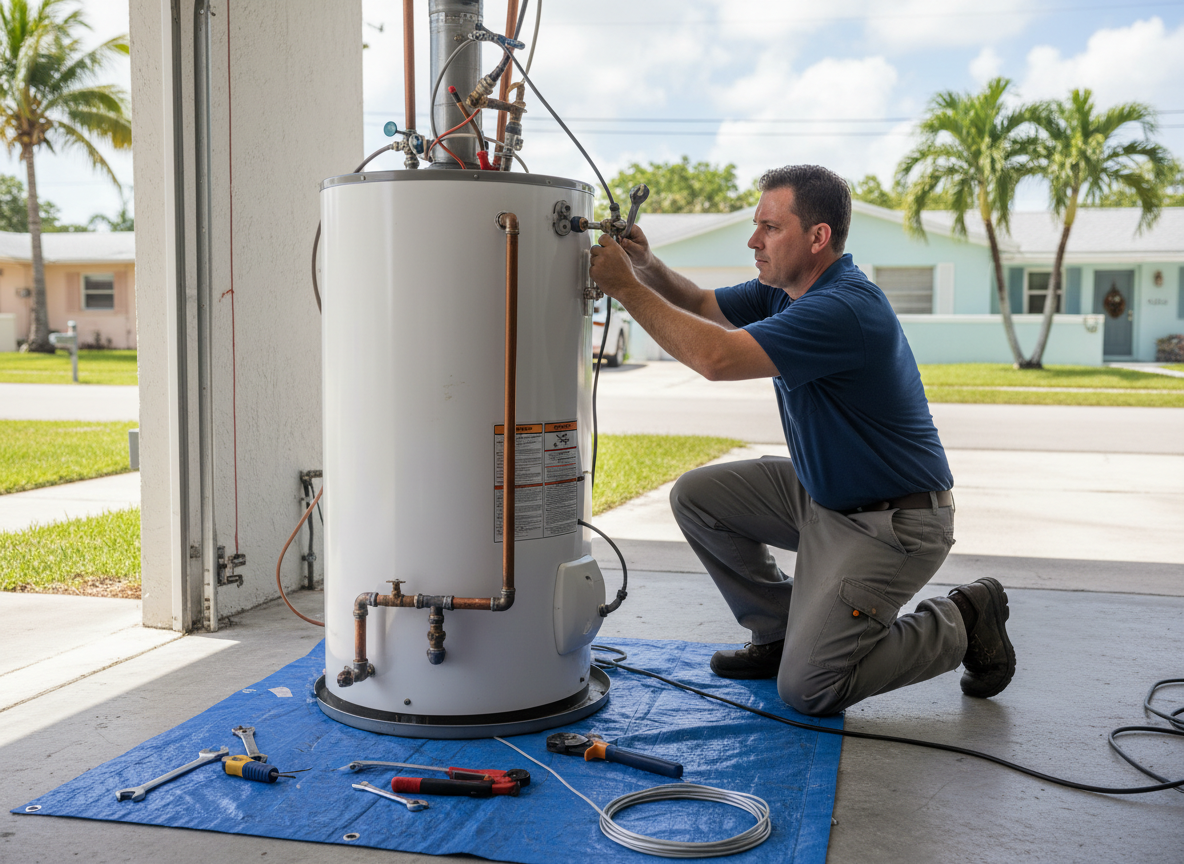
Water Heater Repair
Diagnosis-led repair for tank, tankless and heat pump water heaters in Miami, from no-hot-water faults to leaks, scale and control failures.
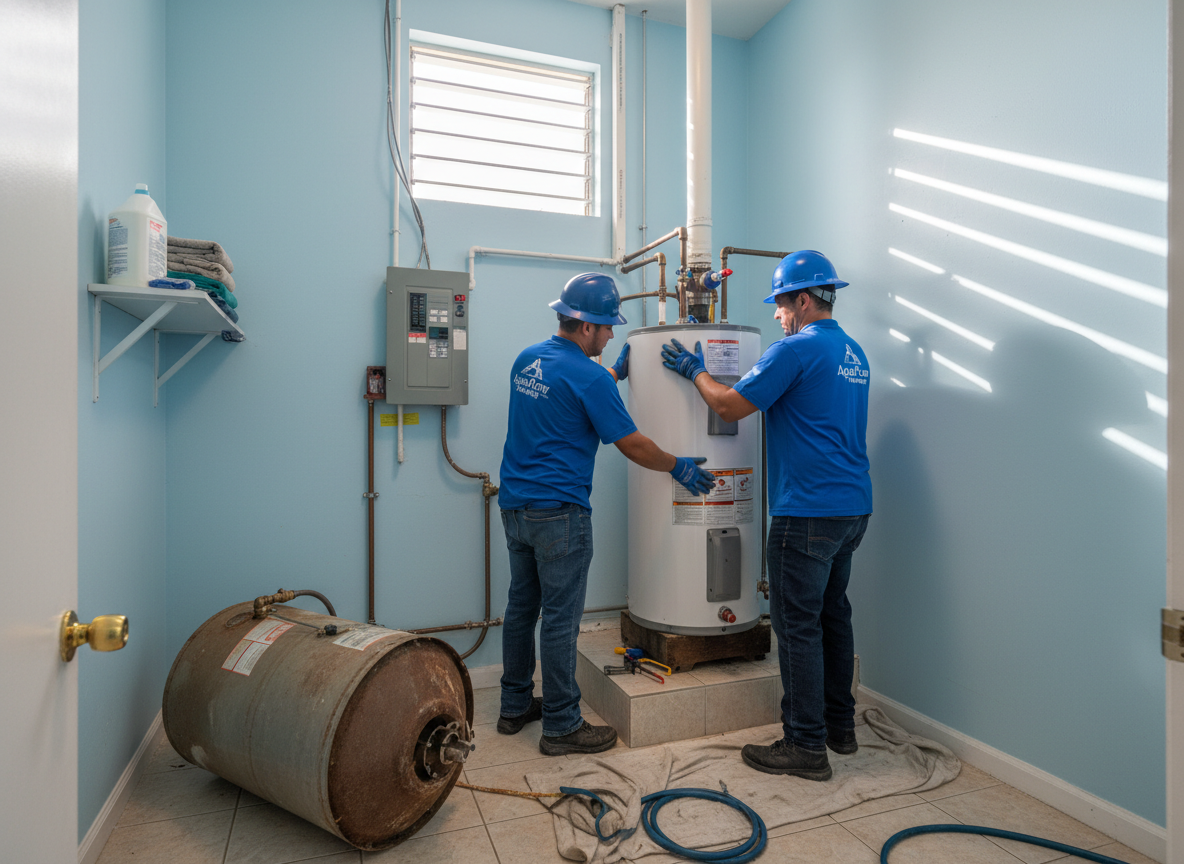
Water Heater Replacement
Replacement of a failed or undersized water heater in Miami, with fuel type, venting, pan and permit pathway matched to the building.
Water Heater Installation
New water heater installation in Miami for renovations, conversions and relocations, including tankless, heat pump and tank units.
Coverage
Miami Areas Covered From the Venetian Causeway
How a job runs
From first symptom to a working heater
Describe the Symptom
The starting point is what the heater is doing: no hot water, not enough hot water, water on the floor, a noise, a smell, an error code, or a breaker that will not stay set. The address and the type of unit narrow the visit before anyone arrives.
Confirm the Unit and Its Location
On site, the technician records make, model, capacity, fuel type and age, then notes where the unit sits: garage, closet, attic, service balcony, mechanical room or exterior alcove. That determines access, venting, drainage and what a pan has to do.
Test in Sequence
Power or fuel is checked first, then the controls, then the heating components, then the tank and its connections. Water pressure and expansion control are checked wherever a relief valve is weeping. Each result eliminates a cause.
Explain the Finding
The fault is described in plain terms, along with what it means for the rest of the unit. Where repair and replacement are both viable, both are explained, including what each assumes about the condition of the tank.
Carry Out the Work
The agreed repair, replacement or installation is completed with water shut off and power or gas isolated first. The area is protected, old parts are shown where it helps, and the space is left dry and clear.
Test and Hand Over
The unit is refilled, purged of air, brought up to temperature and checked for leaks at every joint that was opened. Settings, the shutoff location and the maintenance the unit needs are explained before the technician leaves.
Water heater notes
Water Heater Guides for Miami Homes
Common questions
Water Heater Questions From Miami Households
The contact page lists the business address and the areas covered.