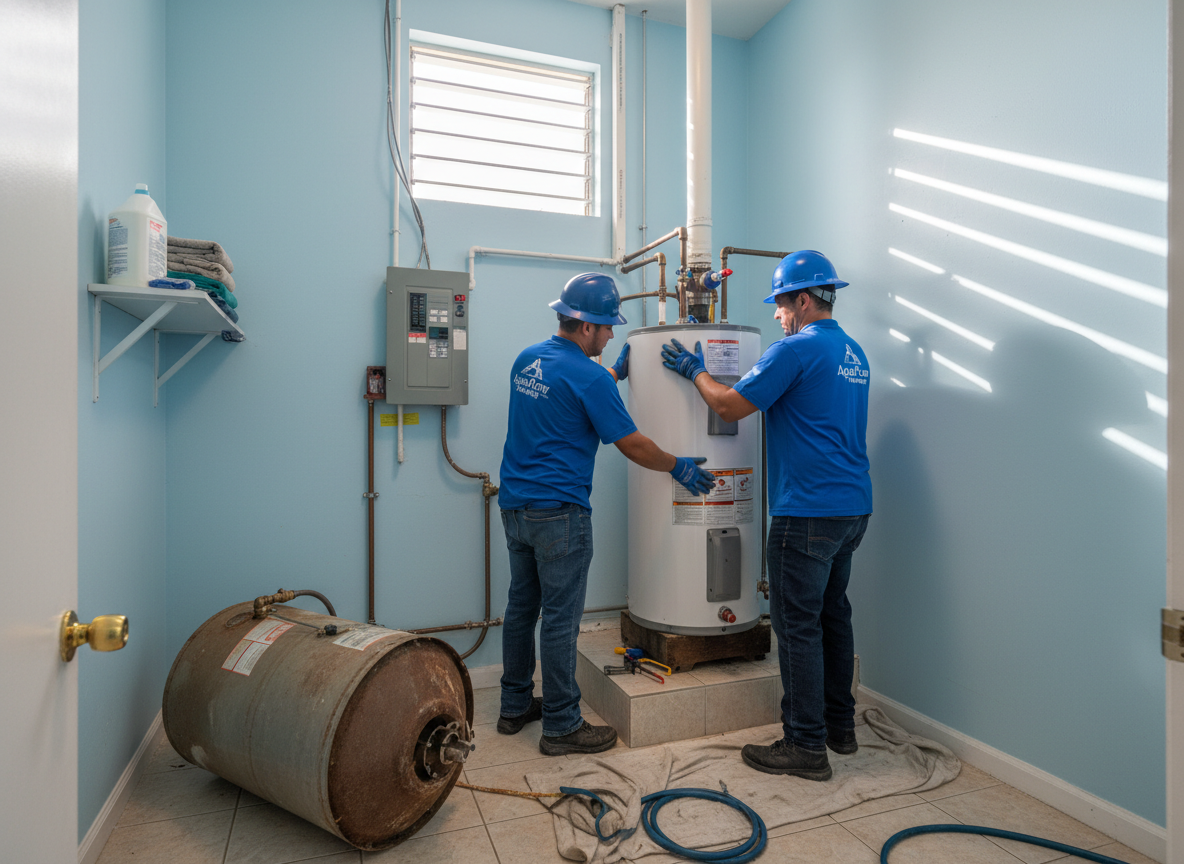
Water heater replacement in Miami is a decision about a unit that has reached the end of its working life. A tank leaking through its shell, a heat exchanger that has perforated or a unit whose parts are no longer manufactured are replacement cases, not repair cases. The job is to confirm that, then plan a swap the building can actually accommodate.
When Replacement Is the Right Answer
A leak from the tank shell ends the conversation. Water coming through the steel itself cannot be sealed, patched or re-gasketed, and no amount of descaling will bring the vessel back. The same applies to a perforated tankless heat exchanger: once the two water paths meet, the unit is finished.
Beyond those clear failures, replacement is a judgement built from evidence. Age is one input, but not the only one. A tank that has needed two major repairs in a year, whose anode is gone and whose floor is scaled solid, is not a good candidate for a third repair. A unit that has been repaired once, holds temperature and has a sound shell may well be worth keeping.
Size and fit are the other half of the decision. A household that has added a bathroom, a second shower or a large tub can outgrow a tank that was correctly sized for the original occupants. Endless recovery, running out during the morning routine and a unit that never seems to catch up are capacity complaints, not faults, and no repair fixes them. The same is true of a tankless unit specified for one bathroom and now serving three fixtures at once.
There are also cases where the unit is sound but the installation is not. A heater without a pan above living space, a gas unit vented into a space that cannot supply combustion air, a relief valve with no discharge pipe, or a unit sitting in a location the code no longer allows will come up at the next inspection. Replacing is often the moment those are corrected, because the work is already open.
What replacement is not is a default answer to a fault. A failed element, a sticking thermostat, a thermocouple, a flow sensor or a scaled heat exchanger are all repairable on a unit with life left in it. Recommending a new tank for a repairable fault is the most expensive mistake in this trade, and the diagnosis exists to prevent it.
What a Replacement Involves in Miami
A replacement is more than disconnecting one unit and connecting another. The old unit has to be drained, disconnected and removed, which in a Miami high-rise means booking the service elevator, protecting the corridor and planning how a full tank comes out of a closet. On the islands and in single-family streets it means planning the route across a driveway or a narrow side yard, and on an attic installation it means enough hands and a clear path.
The opening is then checked for water damage. A platform that has been sitting wet, a pan with a blocked drain or drywall that has been quietly soaking for months is dealt with before a new unit goes in. Setting a new tank onto a wet platform is how a replacement inherits the last unit's problem.
The new unit is set level and connected with new flex connectors, a new temperature and pressure relief valve and a discharge pipe that terminates safely. Where the system is closed by a check valve or a pressure-reducing valve, a thermal expansion tank goes on. On gas, the flue material, slope, termination and combustion air are matched to the new unit. On electric, the circuit, bonding and disconnect are confirmed.
Commissioning closes the job: fill, purge the air, check every joint for leaks, verify the outlet temperature, test the relief valve, and complete the inspection the authority requires. The old unit leaves with the crew rather than sitting at the kerb.
How the Replacement Visit Runs
The first step is confirming the decision, not assuming it. The condition of the tank, the repair history, the age and the household's demand are reviewed together, and if a repair is still the better answer that is said plainly.
Then comes the survey. Fuel type, venting route, electrical capacity, water pressure, space, access and drainage are checked at the actual location. In a condo, that includes the closet dimensions, the riser connection and the building's rules on when work can happen. In a house, it includes the route the old unit will take out and the new one will take in.
The permit pathway is chosen for the address. That is not a formality in Miami-Dade, because the authority changes from island to island and from city to unincorporated county, and the documentation changes with it.
The swap itself is scheduled, with water and power or gas isolated, the area protected and the old unit removed. The new unit is set, connected, vented and protected against expansion, then filled and commissioned.
The handover covers the model and serial numbers, the shutoff and drain locations, the relief valve, the settings and the maintenance the unit will need in local water. It also covers what to expect in the first week, because a new heater behaves differently from a failing one and the household should know why.
What Is Included in the Replacement
Removal and disposal of the old unit is included, along with draining it and getting it out of the building without damage. New flex connectors, a new relief valve and a new discharge pipe are part of a compliant installation rather than optional extras, and an expansion tank is added wherever the system is closed.
Where the unit sits above living space, a pan and a drain line are part of the work. On gas, the venting is checked and corrected to suit the new appliance, including the flue material and the combustion air for the space. On electric, the circuit and bonding are confirmed before the unit is energised.
The permit and inspection are handled for the address where the authority requires them, and the old unit is removed rather than left behind. Commissioning, a leak check at every joint and a walk-through of the shutoff and relief valve close the job.
What is not included is anything the building needs beyond the water heater itself: a failed riser valve, damaged drywall, a blocked condensate drain from another appliance or a platform that needs structural repair. Those are identified during the survey so they are not a surprise on the day.
Miami Conditions That Decide the Replacement
The permit question is the first local condition, and it is more complicated here than in most cities. The Venetian Causeway is a municipal boundary: islands along it alternate between City of Miami and City of Miami Beach jurisdiction, and unincorporated addresses fall to Miami-Dade County. City of Miami Beach lists replacement of water heaters, same for same, among its over-the-counter plumbing permits, which need no plans or technical review; anything that is not an exact replacement does. Miami-Dade County's plumbing guidance is similar in spirit: an exact replacement of an electric, gas or solar unit does not need plans, but a change from gas to electric does, and so does a brand-new installation.
Fuel type drives the scope. A like-for-like electric swap in a garage is the simplest case. A gas replacement needs the flue and combustion air checked, and a gas-to-electric or electric-to-gas change is a different permit, a different set of plans and often a different electrical load. Deciding that before the unit is ordered is what keeps a two-hour job from becoming a two-week one.
Building type drives the logistics. In a Brickell or downtown tower, the unit usually sits in a closet fed from a riser, and the replacement has to work around building hours, elevator bookings and neighbours. On the residential islands and in single-family neighbourhoods, the constraints are the gate, the driveway and the age of the shutoff. In an attic, the constraint is the hatch and the ceiling below it.
Water pressure matters in tall buildings. A replacement on an upper floor should include a look at the pressure-reducing valve and the expansion tank, because a new tank will fail the same way the old one did if the pressure problem is left in place.
Salt air and flooding shape the choice of unit and its location. An exterior closet on Key Biscayne or along the bay takes salt spray, so vent terminals and connections need inspecting more often. A ground-floor utility room in a low-lying area can take on water in a storm, and a unit that has been submerged is not reused, even if it looks intact.
Finally, the water itself. Miami-Dade's aquifer supply is lime-softened to reduce hardness, but scale still forms on elements and tank floors. A replacement is the moment to fit a unit the household can maintain, and to explain the flushing and anode checks that decide how long it lasts.
Related Replacement Work
Replacement rarely stops at the appliance. The items below are the work that commonly travels with it, and each is assessed during the survey rather than added afterwards.
Water Heater Replacement Services We Offer
✓Like-for-Same Tank Replacement
A swap of a failed storage tank for one of the same type, fuel and capacity, with new connectors, relief valve and pan where required.
✓Tank to Tankless Conversion
A change of unit type that involves gas line capacity, vent material, condensate and often an electrical upgrade for the controls.
✓Gas to Electric or Electric to Gas
A change of fuel that is treated as a new installation for permitting, with plans and the electrical or gas work that goes with it.
✓Heat Pump Replacement
A heat pump unit needs space, airflow and a condensate route, and the replacement is planned around the room it has to work in.
✓Capacity Increase
A larger tank or a higher-output tankless unit for a household that has outgrown the original specification.
✓Pan and Drain Line Installation
A pan with a working drain where the unit sits above living space, which is what limits damage when a tank eventually fails.
✓Expansion Tank and Pressure Control
A thermal expansion tank on a closed system, and a look at the pressure-reducing valve where supply pressure is the real fault.
✓Venting and Combustion Air Correction
Flue material, slope, termination and combustion air brought into line with the new appliance and the space it sits in.
How it works
- 1
Confirm the Decision
The condition of the tank, the repair history, the age and the household demand are reviewed. If repair is still the better answer, that is said plainly.
- 2
Survey the Location
Fuel, venting, electrical capacity, water pressure, space, access and drainage are checked where the unit actually sits, including the route in and out.
- 3
Choose the Permit Pathway
The authority for the address is identified, and the application matches the scope: exact replacement or a change of type.
- 4
Remove and Prepare
The old unit is drained, disconnected and removed, and the platform, pan and surrounding area are checked for water damage.
- 5
Install and Protect
The new unit is set level, connected with new fittings, vented to code and protected with a relief valve and expansion control.
- 6
Commission and Inspect
The unit is filled, purged, leak-checked and brought to temperature, with the inspection completed where one is required.